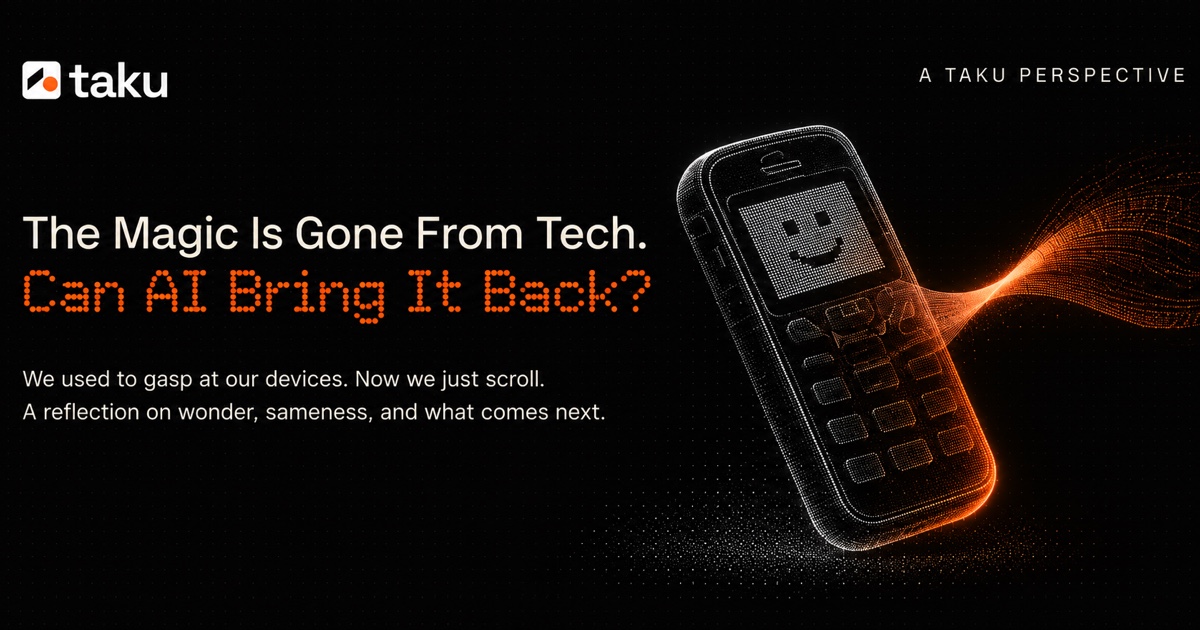
The Magic Is Gone From Tech. Can AI Bring It Back?
November 10, 2026
I remember the first time a computer did something I didn't expect.
It was a slow family computer with a fan that sounded like a small airplane. I typed something, pressed a key, and the screen responded. It wasn't smart. It barely worked. But for a moment, the box on the desk felt almost alive. It felt like I could talk to it.
Then came the first phone that was truly mine. I spent an entire evening changing the ringtone, rearranging icons, and taking blurry photos of my own hand. None of it was particularly useful. All of it felt like magic.
If you grew up around the same time, you probably have your own version of this story. The first game that let you build a world. The first time a map helped you find your way. The first message that arrived from someone on the other side of the planet in less than a second.
Back then, technology felt like a door opening.
Somewhere along the way, the door became a wall.
Take a look at your phone right now.
A grid of rounded squares. Each one a separate little room. Each with its own login, its own settings, its own idea of who you are.
You move between them all day, copying things from one to another, like a courier who never gets paid.
The apps themselves have started to look the same, too. The same feeds. The same tabs at the bottom. The same recommendations. The same endless scroll.
It's not that anyone did anything wrong. Every product became a little more optimized, a little more polished, a little safer. Every interaction got smoother. Every edge got rounded off.
And somewhere in all that polish, the surprise wore off.
Our devices got faster every year. They didn't get more wondrous.
We stopped saying "whoa." We started saying "update available."
Then AI showed up, and for a moment, it felt different.
The first time many of us talked to a modern AI model, something old came back.
That same feeling from the family computer:
Wait. It understood me?
It wrote a poem. It explained a tax form. It helped debug code at 2 a.m. It turned half-formed thoughts into something useful.
For a few weeks, the internet was full of people sharing screenshots with the same excitement we once had when showing off a new ringtone.
But notice where all of that happened.
Inside one more app. One more window. One more box on the home screen.
Some of the most capable technology of our generation still spends much of its time waiting in a text field, asking us to copy and paste the world into it.
It can describe your life in detail. It still can't quite live in it with you.
That's not a criticism of anyone building these models. It's just an honest observation: intelligence got a massive upgrade. The experience around it mostly didn't.
What did magic actually feel like?
When I think back to those early moments, the magic was never really about specifications.
It came down to three simple feelings.
It surprised me. The device did something I didn't know it could do.
It felt personal. It was my phone, my world, arranged my way.
I was in control. I was exploring it, shaping it, making it mine — not simply being guided through someone else's idea of how it should work.
Most of today's technology gets maybe one of these right. Sometimes two. But the experiences we remember most vividly had all three.
So the question we keep coming back to isn't simply, "How do we make AI smarter?"
Plenty of brilliant people are already working on that.
The question is closer to:
What would it take for technology to feel like that again?
Surprising. Personal. And still yours.
Black and white, then color.
There's an image our team keeps returning to.
An old phone, the kind you might find forgotten in a drawer at your parents' place. Black and white. Familiar. A little forgotten.
And then, slowly, color starts to come back.
Not because it got a bigger screen or a faster chip. But because something about the way it understood you changed. Because technology started to feel less like a collection of disconnected rooms and more like something that could adapt to you.
We don't think the magic is gone for good.
We think it's been waiting for the right moment to come back.
We're working on it.
We're a small team of builders, designers, and people who still remember what it felt like to be amazed by a screen.
We've spent a lot of late nights thinking about that feeling, and asking ourselves what it would take to bring it back.
We're not ready to show you what we're making. Not yet.
But if any part of this story felt familiar, if you miss the "whoa" too, stick around.
We'd love for you to be there when the color comes back.
Taku. Your world, on your terms.
— The Taku Team