
Let's Make Phones Fun Again
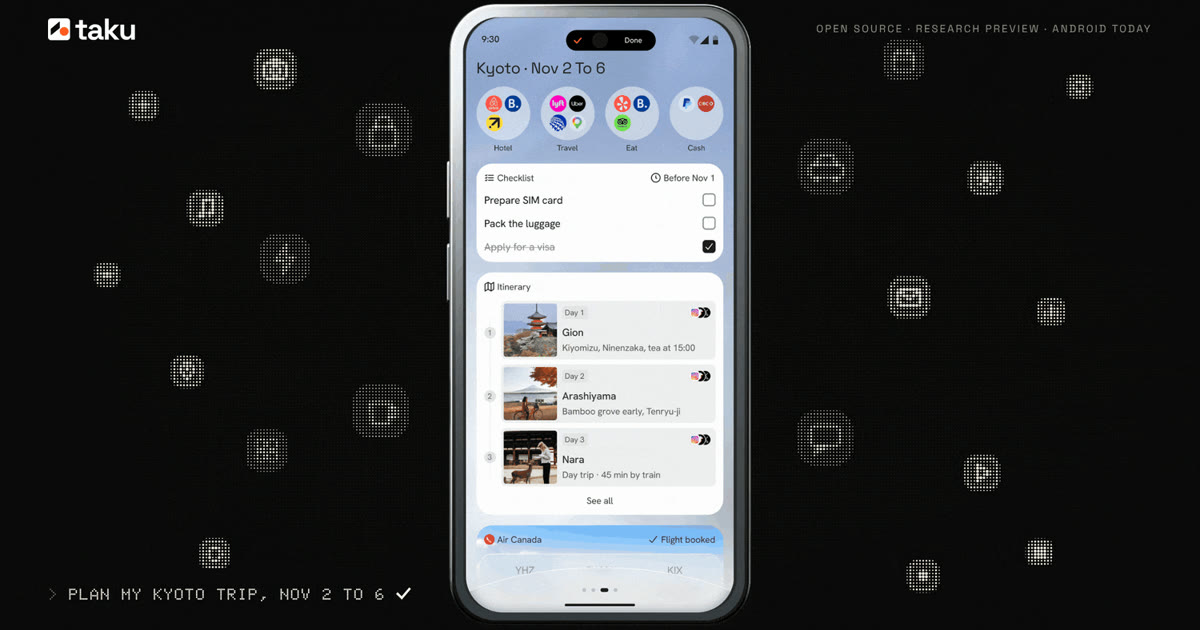
We made phones more powerful, more polished, and more predictable. Then AI arrived and changed what software could become. We think it's time to make phones interesting again.
Remember when phones were fun?
There were flip phones, sliders, tiny keyboards, strange designs, and applications that existed simply because someone thought they would be cool to build. You could customize things, experiment with features, discover unexpected tools, and sometimes spend an afternoon making your phone do something completely unnecessary.
That was part of the magic.
Phones weren't just communication devices. They were personal computers that invited people to explore.
Then smartphones became mainstream. The industry standardized around touchscreens, app stores, application grids, and familiar interaction patterns. Our devices became dramatically more capable, but the experience of using them became increasingly predictable.
Today, we carry extraordinary computing power in our pockets, yet most of our interactions still follow a familiar pattern: open an application, navigate its interface, perform an operation, switch to another application, and repeat.
We have an app for almost everything. But we're still the ones connecting everything.
And perhaps we've spent so long optimizing the smartphone experience that we've forgotten to ask a more interesting question:
What else could a phone become?
AI changes what software can be.
The arrival of increasingly capable AI models changes the assumptions we've built around software.
For decades, applications were designed around predefined functions and interfaces. Developers anticipated what users might want to do, implemented the relevant features, and organized them into workflows. Users learned those workflows and adapted their behavior accordingly.
AI introduces another possibility.
A person can describe an intention without knowing exactly which application, API, or sequence of operations will fulfill it. An agent can interpret the request, retrieve relevant context, select tools, coordinate actions, and potentially create an interface around the desired outcome.
This is a meaningful shift from application-centric computing toward something more dynamic and intent-driven.
Consider a simple example: planning dinner with friends.
The conversation happens in a messaging app. Restaurant preferences are scattered across messages. Availability lives in calendars. Reviews and location information exist elsewhere. Booking requires another service.
Today, the user acts as the integration layer between these applications.
But what if an agent could connect those pieces of context and bring them together into one actionable plan?
What if the same principle applied to finding something you saw yesterday, comparing prices between a physical store and an online marketplace, or turning a simple idea into a small application?
The interesting part isn't that AI can answer questions about these tasks.
It's that the boundary between using software and creating new software experiences may become increasingly thin.
AI shouldn't have to live inside another application to help us use our computers.
We believe intelligence deserves a place closer to the operating system, where it can work with the broader capabilities of the device.
That's the idea that led us to Taku OS.
From an assistant to an agent-native operating system.
Taku is an operating-system company building for an era when AI is simply how computers work.
Taku OS is our exploration of what happens when an AI agent becomes part of the operating-system experience rather than remaining confined to a standalone application.
It's built on Android and designed around an agent layer that brings context, commands, actions, and device capabilities together.
The Feed is one expression of this idea. Instead of making every interaction begin with opening an application, it brings relevant information and actions into a shared environment.
Underneath that experience, the system explores how an agent can work across supported applications, interact with system capabilities, use device hardware, and create new experiences.
This is not simply about adding a chatbot to a phone.
It's about rethinking the relationship between the user, the applications, the operating system, and the hardware.
And we wanted to test that idea through real engineering, not just a concept video.
What have we actually built?
We don't want to talk about the future of computing only in abstract terms. We want to show what we're experimenting with today.
Here are some of the directions we've already implemented or demonstrated in development.
1. From conversations to coordinated plans
We've demonstrated a cross-app group dinner workflow.
Imagine a conversation in which several friends are trying to decide where to eat. The agent can extract restaurant preferences, identify scheduling constraints, and bring relevant information together into a Group Dinner Panel.
Instead of manually moving between conversations, calendars, restaurant information, and booking services, the experience explores how those pieces can be coordinated around one task.
The underlying cross-app capability has been demonstrated. Adaptation to individual services and the complete end-to-end reservation workflow are still being refined.
2. From something you saw to something you can find again
We've explored contextual retrieval using information from previous screen interactions.
The idea is simple: you remember seeing something, but not where.
You can describe it rather than reconstructing the entire browsing history yourself.
The envisioned workflow uses screen context and visual information to help identify previously encountered content.
Some of this experience remains conceptual and under development, rather than a generally available capability.
3. From looking at a product to understanding its real price
We've implemented a shopping comparison flow that explores visual recognition, price extraction, currency conversion, and cross-source comparison.
The idea is to recognize a product, retrieve its visible price information, convert currencies where needed, and place the comparison into a more useful view.
The goal is to reduce the work between seeing something and making an informed decision.
4. From a difficult conversation to actionable information
We've been working on AI-assisted call capture and summarization.
A fast customer-service conversation can be difficult to follow, especially when important details are spread throughout the call.
The workflow explores recording, transcription, key-point extraction, and the generation of a structured call summary with next steps.
Rather than leaving someone with a long transcript, the aim is to turn a conversation into something they can actually use.
5. From an idea to a working interface
This is one of the possibilities we find particularly exciting.
What if you could describe a tool you need instead of searching for an existing application?
We've demonstrated a menu-scanning experience that takes a photographed menu, recognizes dishes, generates corresponding food imagery, and presents additional information such as estimated calories.
We've also been exploring dynamically generated task panels.
For example, imagine saying:
"I have a half marathon in three months. Help me prepare."
The idea is to generate a dedicated workspace around that goal, combining a training plan, nutrition information, and relevant external resources.
These experiences illustrate a different approach to software creation: generating interfaces and workflows around a specific intention.
Not every generated workflow or external integration is fully implemented, but the direction is worth exploring.
6. From device hardware to new capabilities
A phone already contains a camera, microphone, audio system, sensors, Wi-Fi, and Bluetooth.
Yet most applications use these capabilities in relatively predefined ways.
We've demonstrated natural-language camera customization, including turning a reference image into a camera filter.
We've also explored real-time virtual try-on and generative visual experiences.
The broader question is whether an agent can help people create new interactions with hardware without requiring every possible experience to be designed as a traditional application in advance.
7. Beyond the screen: Connecting physical devices
We've experimented with controlling external devices, including a Tesla development demonstration and a robot dog.
We've also demonstrated bidirectional translation using a phone and Bluetooth earbuds: Japanese speech is translated into Chinese through the earbuds, while the reply is translated back into Japanese through the phone speaker.
These experiments are interesting because they move the agent beyond the boundaries of the screen.
The device becomes part of a larger environment of connected hardware and physical interactions.
8. From forgotten information to useful memory
We've implemented a memory workflow that allows users to save information from their digital experiences and retrieve it when relevant.
One example is saving a travel post and bringing it back when the user arrives in the relevant location.
Another explores turning screenshots of events into calendar information.
The larger idea is that personal agents should not only understand the current request. They should also be able to work with useful context from previous interactions.
Memory should remain inspectable and manageable by the user.
These are not all equally mature features. Some have working development demonstrations, some have been implemented in specific environments, and others remain concepts or are still being refined.
We think that distinction matters.
The purpose of this project isn't to pretend every possibility is already solved.
It's to explore how far we can push the idea.
The interesting question isn't only what AI can do.
It's what AI cannot do yet.
We are fascinated by the possibilities of AI, but we're equally interested in its limitations.
Can an agent reliably coordinate a task across applications that were never designed to work together?
Can it distinguish an instruction from a suggestion?
Can it recover from a failed action without losing the user's context?
Can it generate a useful interface rather than simply another generic screen?
Can it interact with physical hardware while respecting device permissions and safety boundaries?
Can it remember the right information without collecting everything?
Can it understand what a person means when the instruction is incomplete, ambiguous, or changes halfway through a task?
These are not hypothetical engineering inconveniences. They are real problems that emerge when an AI agent moves from a conversation window into a computing environment where its actions have consequences.
We don't believe the answer is to give an agent unrestricted access to everything.
The operating system still needs permissions, defined capability interfaces, validation, and appropriate user confirmation.
An agent's ability to reason about an operation is not proof that the operation was executed successfully.
A model saying "Done" is not the same as a task being done.
The gap between intelligence and reliable execution is one of the most important areas we want to explore.
And we want to hear from people who are curious about the same questions.
What do you think AI should be able to do? What should it never be allowed to do? And what ideas have you had that today's phones simply cannot support?
We opened the system because we don't have all the answers.
Taku OS is an open-source, Android-based operating system with an integrated AI agent.
Its architecture includes a system-side Assistant and task service, a React Native agent interface, a protocol and SDK layer, Android adapters, Memory, and a plugin system.
We are exploring a modular architecture in which models, agent harnesses, tools, Skills, and connectors can evolve independently through common interfaces.
One engineering principle is particularly important to us: Agent Parity.
If a supported operation can be performed through the graphical interface, the agent should have an appropriate way to discover and perform that operation using consistent state and validation.
We don't want to build one version of a capability for humans and another disconnected version for agents.
We want the system to treat both as legitimate ways of interacting with the same underlying capabilities.
The project is open source under Apache-2.0. The public repository covers the system ROM and documentation, while server-side services and third-party components have separate licensing boundaries.
We made this decision because we don't believe the future of computing should be defined entirely by a single team's imagination.
A small team can start an experiment. But a community can discover possibilities that the original builders never anticipated.
We want developers to fork the system, inspect its architecture, modify core behavior, build plugins, connect different models, report bugs, and contribute new ideas.
We want people to challenge our assumptions.
We want people to tell us what doesn't work.
And we especially want to hear about the things they wish their phones could do.
Make phones fun again.
There is a reason we keep coming back to this idea.
Computing used to feel like an invitation to experiment. You could change things, discover unexpected tools, build something strange, and make a machine behave in a way that felt personal.
Somewhere along the way, the smartphone became an incredibly polished but increasingly standardized experience.
AI gives us an opportunity to rethink that.
Perhaps applications will become more dynamic. Perhaps interfaces will be generated around individual goals. Perhaps hardware capabilities will become easier to combine. Perhaps the distinction between using software and creating software will become much smaller.
We don't know exactly what the phone of the future will look like.
But we believe it should be more personal, more adaptable, and more open to experimentation than the devices we have today.
We don't want to decide every possible thing a phone can become.
We want to build a foundation that makes it easier for people to discover what it could become.
Taku OS is an early-stage Research Preview. It's intended for testing and development, not everyday work use. Compatibility and feature availability vary by device and application.
If you're a developer, a hacker, an AI agent builder, or simply someone who has ever looked at a phone and thought, "I wish it could…", we'd love to have you explore it.
Try it. Break it. Question it. Build something we haven't thought of.
And tell us what you wish your phone could do.
We're open source. We're still experimenting. And we're open to your voice.
Let's make phones fun again.
Taku
The OS for your "I wish it could…" moments.
- Explore Taku: taku.ai and Taku Phone
- GitHub: github.com/Taku-OS/taku-os
- Developer Docs: docs.taku.ai
- Join the community: Discord
Taku OS is an early-stage Research Preview for testing and development. It is not recommended for everyday work use. Feature availability and compatibility vary by device, application, and build.